Tuesday, June 8, 2010

Day 9 Part 1 - Helsinki

There's no testing the water here. We dove right into the city, splitting the city center into quarters. The eighteen of us broke into four groups and each took a quarter of the city to walk around, observe and document for four hours. I had the top left quarter with Leto, Aswin, Jo and Jess.


Leto and I took the coastal area, beginning with the edge of the industrial section at the bottom of the quarter, then north through the cemetery.

We started walking from the bottom right corner of our section. We noticed as we got closer to the harbor that the amount of construction dramatically increased. Helsinki seems to be growing rapidly at the edges, and is very unlike Reykjavik, whose buildings seems to be frozen in the 1960s.

It's difficult to perceive the topography of Helsinki right away, but there are definitely changes in grade, hills and slopes. Rather than carve into the landscape, Helsinki moves with it, although there are some moments of cutting where different modes of transportation pass over or under each other.


This photo is of a pedestrian underpass. The highway above defines the edge between the dense city and the more scenic cemetery.


I wish there were an easier way to document sounds. There is video, of course, but that in itself is pretty limiting. It's easy to draw, take photos and gather pamphlets, fliers and postcards. It's difficult to record a sound unless you're very quick, or very lucky. Just after this photo was taken, two boys on skateboards rode past us down the path. Their skateboards clattered noisily over the brick, the sound of which reverberated endlessly against the glass and concrete enclosure.

Helsinki's citizens share one large, collective cemetery on the western edge of the city. I'm not sure if the cemetery itself is sectioned off and if it is, according to what criteria. To Leto and I, the cemetery was a literal city for the dead, with endless rows of densely packed gravestones. The weather was absolutely beautiful, as it has been for the entire duration of the trip thus far. The sunlight streamed through the trees, filling the space beneath the canopy with a lovely glow.


Unlike the cemeteries I'm used to, which are solemn and elicit voices no higher than a whisper, Helsinki's was full of activity and bustle. Joggers and bikers used the road that separated the cemetery's edge from the water, mothers pushed strollers, sometimes accompanied by older children. We turned off the road and walked through the cemetery towards the main church. We stood on the front steps, turned away from the doors and saw, about 200 meters down a path, a beach!  Notwithstanding Leto and I thought it was certainly not beach weather, the sight of families laughing and playing at the edge of a cemetery caught me off guard. Surely a cemetery was a place of quiet and reservation?

It's evident that Finns have a special relationship with their departed, and the nature of that relationship is to keep them close and part of their activities. By no means would I say Finns are obsessed or overly conscious of the dead, but if I may draw connections on mere observation (we didn't talk to anyone, regretfully), Finns treat their capital's cemetery as a place to be shared by the living and the dead.

This is a two-part post! Stay tuned for more from my first full day in Helsinki!

Sunday, June 6, 2010

Day 8 - En Route to Helsinki

Most of the day was spent getting from Reykjavik to Helsinki. We had a nice 5am bus ride out to Keflavik Airport for our 7:50am departure. Four of us, myself included, took a separate flight connecting in Oslo. We didn't spend much time there, as our Reykjavik flight departed late, causing us to sprint to the next gate. Fortunately our bags moved as quickly as we did, and they were waiting for us at the claim belt.

It was an exhausting day and as such, I took hardly any photographs. I'll share the one good one with you all, of the building directly across the street from our hostel:

As part of an ongoing assignment, we have to make eight postcards (one for each week) to mail back to CMU. I made one for Iceland the previous night and took a photograph of it, in case something happens to it in transit. I focused on the textures and materials of Iceland, like the grass, stone, lava rocks and all of things that resonated about my Icelandic experience. I also included a map of our journey, for posterity's sake.


The rest of the day was spent sleeping off the traveling and early morning wakeup. The real Helsinki adventure begins the next day!

Day 7 - Reykjavik

Since this was a Sunday, we had the day off to do as we wished. The group broke off to do their own things. Some went horseback riding, some went to the Blue Lagoon. I took the morning to sleep, then went out and walked the city in the afternoon with Nico. We stopped first at Hallgrímskirkja, an iconic church that resembles an organ.


Hallgrímskirkja was designed by Guðjón Samúelsson in 1937. However, construction didn't begin until 1945 and took until 1986 to complete. The church tower underwent significant restoration from 2008 - 2009 so we saw the church in excellent condition.

The pervasive concrete continues on to the interior, whose starkness reflects the harsh, even barren landscape of rural Iceland.


I found a nice detail in the pews. The pew backs can be tilted to reverse the orientation of the sitter to face the front of the back of the church. A little block is wedged in between two joining seats to lock the pew back in place and can be removed easily to tilt the back.


The most rewarding part of the visit was the elevator ride to the observation deck in the tower, which looks out over the entire city of Reykjavik. As a side note, the observation deck is situated directly below the bell chimes, separated only by a wooden deck.

The day was stunning and the views of the city and surrounding mountains equally so. The following view is of Tjörnin Lake. City Hall is on the right hand edge of the lake. I believe this view is to the west.


Here's a view of Perlan, a museum/restaurant/cultural building. The large cylinders are water storage tanks, although one of the was recommissioned to be an art gallery.


We headed to the flea market next, which seemed to draw a big crowd. The building (nothing to speak of) was packed with various vendors of secondhand clothing, antique jewelry, cheap plastic childrens' toys, inexpensive DVDs, old books, and more. There was a small fish market in the back of the store, but I had smoked shark a few days prior and I wasn't feeling so adventurous anymore. I did buy a watch, since my cell phone could not be used for the time, and managed to get a good deal on one of the few watches that had a working battery. I tried to haggle, but the language barrier was evident, although he knew how to say "Very good price!" with near-authentic accuracy.

We did our best to see as much of the city as possible, and I regret that I spent too much time looking and not nearly enough time recording. At this point, I was used to seeing much of it and didn't think to photograph. The photos I do have are from an earlier day when I wasn't sure why I was taking the picture, but just wanted to record "typical" Reykjavik/Icelandic architecture.


One thing popped out at me about the buildings as a collective: there is a startling lack of ornament. Windows and doors are hardly defined and you wouldn't even know they were there if it weren't for the hole in the wall. Also, there's a consistency in style that I find difficult to define. There isn't much new construction going on because of the economy, but all of these buildings weren't built at the same time. So why do they all look the same? There are a variety of answers and none is the sole explanation. Availability of materials, building convention and climate all play a part to explain why Reykjavik looks as it does.


I saw this sign near an intersection. Not entirely sure what it means, but it involves 30km/hr.


For dinner, a few more of us joined up and went out for a special Icelandic culinary experience: puffin meat. Puffin are plentiful on some of the islands near Reykjavik and serve as exotic fare for the locals and tourists. The meat is a deep beet red, more red than beef. According to science, sea birds have red meat, as opposed chicken or turkey on land. The meal was exquisite and the restaurant was so appreciative of our patronage (or took pity on us, or thought all of the girls looked attractive) that our waiter brought out a sample platter of whale meat, which was also delicious. It was a very fitting way to end our week in this beautiful country.

So concluded our stay in Iceland. Stay tuned for scenes from Helsinki and Finland.

Saturday, June 5, 2010

Day 6 - Reykjavik

Today was a nicely well-rounded day. I saw some architecture, participated in some cultural experiences and met some young Icelanders.

It occurs to me that I ought to be sharing some information about the other students on the trip, since I am only one of eighteen. This bit of trivia ought to be pretty important: 16 out of 18 of us know another language other than English. Between the eighteen of us, we represent English, Korean, Chinese, Japanese, Greek, French, Spanish and German. Most of the people who know these languages have lived/currently live in their respective countries of origin. I wonder about how our increased knowledge and interest in other countries, cultures and languages influences how we travel to and view other countries.

I like to think that in our group, we are "smart tourists". For one, we are all seasoned travelers who have traveled internationally. To know a language is to know something about its associated culture. Language fluency relies heavily upon knowing not only what to say but when and why to say it. Since the majority of us is familiar with another language, we are also somewhat knowledgeable of another country's culture. I believe that we are better able to perceive cultural differences between us and the countries we are visiting on this trip. We are also better at reflecting and thinking critically about our experiences, rather than take them at face value. I'll be expanding more upon these thoughts as I share more of my individual experiences and explain why they are unique for me as "Catherine" and me as "tourist".

Since Day 6 was a Saturday, we only visited one building, Alvar Aalto's Nordic House. On the way there with two other members of the group, Lindsay and Nico, we found ourselves lost. We flagged down a woman walking her baby in a stroller. We attempted to explain in English where we wished to go, but she seemed confused by the name "Nordic House". We had been reminded before that most of the Icelanders living in Reykjavik knew a few European languages, so Nico translated our request in German. The woman brightened up immediately at being able to understand our problem and quickly pointed at the building right across the street and wished us a pleasant stay in Iceland (or so she said in German).

Starting with what happened first, we all met up at Alvar Aalto's Nordic House at the south end of Tjörnin Lake. The Nordic House was designed by Aalto later in his life and, to use the words of my professor Pablo, is a "greatest hits" of Aalto's design moves. The Nordic House is a multipurpose building whose main components feature and small restaurant, assembly hall and library.

I was drawn particularly to the library. I tend to seek out libraries anyway, being an avid reader. I found the Nordic House library to be, by design, warm and welcoming. The stacks were staggered such that they appeared to be unfolding before me, beckoning me to enter.

 The steps near the center of the photograph lead down a half-flight to more stacks and little reading nooks. Although all of the lights were on, the daylight streamed into the space, washing the spines of the books in a pleasant pale yellow glow. The railing in the image becomes the stacks for the lower section of the library, which is entirely open to the entire space.

There is a curious relationship of the upper, outer stacks to the inner, lower stacks. The staggering and angling creates pockets for a few people to cluster around a single stack. Only two or three people can comfortably occupy this space at a time, which makes for an intimate experience.

The main image is a loose axonometric view of the key relationships of the library stacks. You can see how Aalto angled the stacks to create points of tension, where opposite stacks are closer, and areas of release, where the stacks move away from each other. At the top right of the page, a quick section shows the relationship of the lower stacks to the higher ones. The plan diagram simplifies the tension-release relationship between the upper and lower stacks.

I tried my shot at a photo-interior elevation. It's a first attempt, so it's a bit sloppy, but there isn't much I can do to clean it up, and it was a valuable learning experience. I started at one end of the library, facing one wall. I snapped a photo, took one step to the side, snapped a photo, and kept doing that until I reached the other side.  I positioned myself so that I would have to walk down the stairs into the central lower stacks, and that's where things got a little fuzzy in terms of alignment.


Let me know what you think. I'll do more of these when I think it's appropriate. It can be a useful tool for understanding a space in terms of a variety of different relationships.

After studying the Nordic House, we had the rest of the day to ourselves. Now that we had been in Reykjavik for a few days, we were better able to anticipate and appreciate our surroundings. Most Icelanders in Reykjavik speak English quite well, and seem to enjoy certain phrases. I saw this sign on a main street in Reykjavik and wondered if the store did good business:


A small group of us stopped at a grocery store, not because we were looking for anything in particular, but to explore and discover differences in Icelandic food culture. I noticed right away what is special about Iceland's grocery stores. Can you tell what's unusual about this photo?


All of the price tags in the store were digital! It must save a bundle on paper and allow for more efficient price-changing. They must run off the super-cheap electricity made by the geothermal plant!

A staple of Icelandic food culture is Skyr, Iceland's own brand of yogurt. Skyr is positively fantastic. It's a bit heavier than standard American yogurt, but in the sense that it's more filling.  It's made with better ingredients and is supposed to be very good for you. It's a common dessert option at restaurants with berries or pie. I miss Skyr the most of any food I had in Iceland.

We were lucky enough to spend our first weekend in Europe during the finals for Eurovision. For those who don't know, Eurovision is akin to American Idol, for the entire continent of Europe. Each country sends a song (and a band/singer to sing it) to a competition. There are qualifying rounds, two semifinals and a final round. The rule is: you aren't allowed to vote for your own country. Lindsay and I caught some of the semifinals a few days before, but this night was the final round where the countries that survived the first elimination round competed for Eurovision glory.

The competition is held in the country that won the previous year, which meant that Oslo, Norway, hosted the 2010 competition. I'm still a bit bummed that we couldn't have been in Oslo earlier, for the Eurovision competition, but Icelanders are fiercely proud of their country and it wasn't difficult to find a bar with a rowdy bunch of Icelanders rooting for their country. We all cheered along with them, happy to be a part of something that is intended to unite Europeans in the friendly spirit of competition.

Of course, it isn't difficult to understand that many of the songs are political, or at least severely vetted before being submitted for entry. Also, some of the voting trends displayed by certain countries were blatantly political. Still, it was a fun cultural experience, even if Iceland didn't score very well (they didn't even break top 15 when I thought their song deserved top 3).


I'll leave you with a photo of us in our finery ready to hit the town for some Eurovision fun!

Thursday, June 3, 2010

Questions and Answers

I've had one question so far, the answer to which I have decided to share with all of you. 

I am using a three-year-old Canon PowerShot A710 for my photographs. Although I mostly shoot using the "auto" function, I've been testing out the EV function (sort of a combination of TV and AV) and the (however limited) manual focus. For the most part, I'm happy with how the pictures are turning out, despite the age of my camera. If anything, I wish I had rechargeable batteries, since it's a bother and a use of my money to but AAs.

That's all for now. Keep those questions coming!

Day 5 - Return to Reykjavik

The two-day journey to Skaftafell became a one-day, five-hour trip today. We made a few stops along the way, of course, which I will relate to you in words and images.

First, we stopped for a hike around a cluster of waterfalls. The water is all glacial runoff and a few of us stopped to fill our water bottles with the crystal clear river. I've never tasted such delicious water, and it's there for the taking, free of charge. I've never enjoyed drinking water as much as I have in Iceland. Still, I shouldn't have to travel to the ends of the earth just for water that isn't filled with crap. As I write this post, I'm in Helsinki and, sadly, have gone through the bottle of glacial water I made sure to fill before leaving Iceland.

Back to the hike, the first of the waterfalls, Svartifoss, was difficult to photograph, because we only saw it from the top, never from the base. Still, this provided for some interesting photographing opportunities.

This shot was taken just a few steps from the crest of the waterfall, with the flat landscape of the glacial floodplain in the background. I've never been able to get that close to the top of a waterfall before. With the landscape behind, the experience felt close to flying.

The second waterfall we visited, Sjónarsker, was the most underwhelming of the three but the walk there was quite pleasant. We criss-crossed a river, drank some more clean glacier water and spent a few minutes exploring the waterfall and pool. There wasn't much to discover, so we continued on to the final waterfall, Morsárdalur.


Morsárdalur is a few meters high and surrounded by a wall of basalt. The molecular structure of basalt is hexagonal and when rocks break off or break apart they do so in hexagonal cylinders. When sections break off, they do so from bottom to top. The result looks like a crystallized wave.


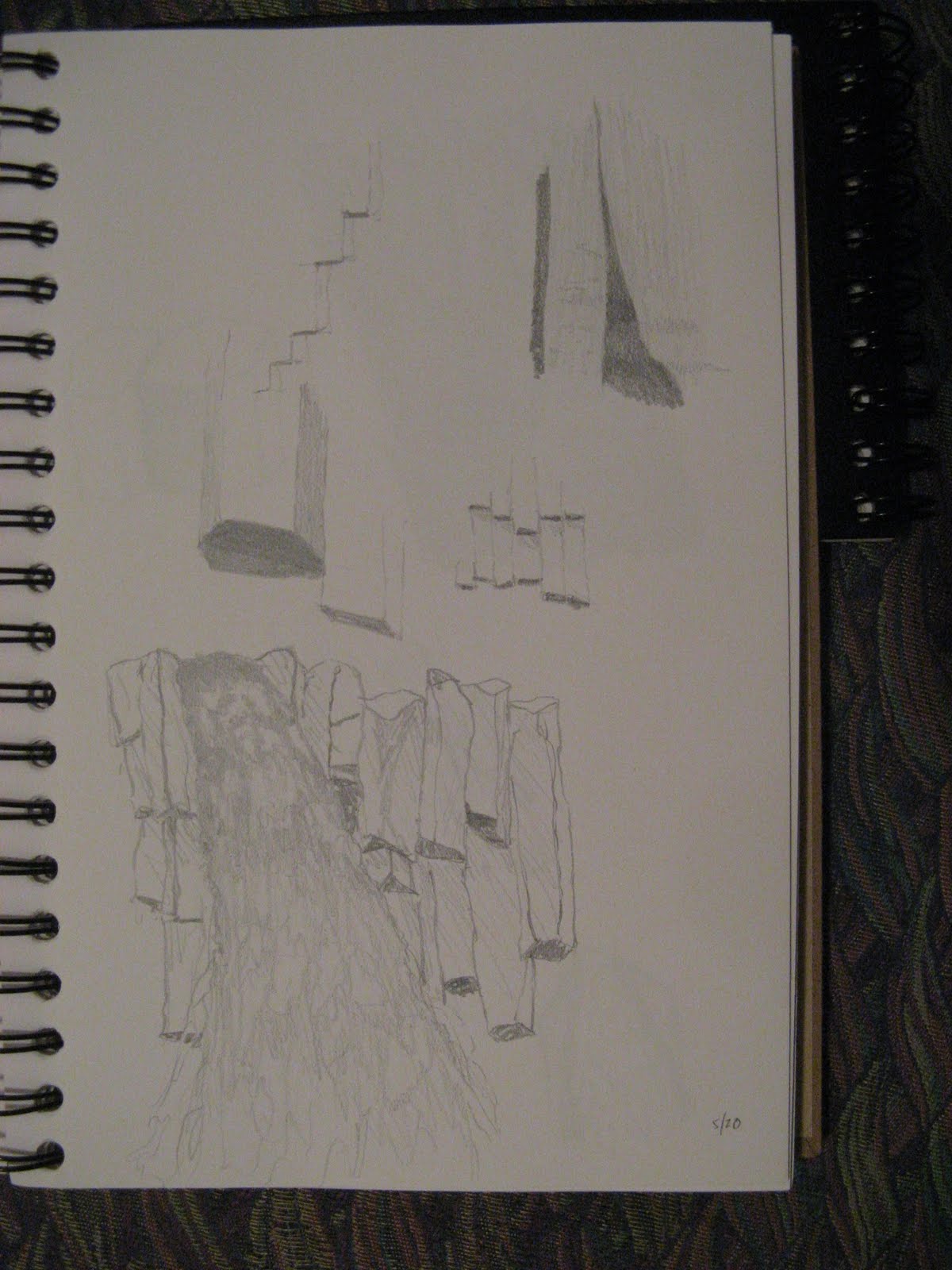
The area around the base of the waterfall was strewn with broken pieces of basalt.  These rocks were, inexplicably, a lighter shade of brown than the basalt wall. A closer look at the wall itself revealed small rivulets of water streaming down, which I'm thinking contributes to the darker shade. We paused at Morsárdalur to sketch the basalt formation. The most difficult thing for me was capturing both the dark shade of the stone, and the light/shadow relationship. Here's a sample page from my sketchbook:

Drawing stone is already difficult for me. The more regular shape of the basalt made things a little bit easier, but I need to do a better job of capturing the essence of unpolished, raw stone. I tend to focus on the outline, relying on the single line of the border of the object to tell most of the information about shape, size as well as texture. "Wild" stone is never completely smooth (unless found in a riverbed or on the beach) and describing that special texture is a useful skill to have.

Our visit to the waterfalls had to end, as all things do. We piled back on the bus and slept through the next few hours to Reykjavik. Before entering the city itself, we stopped at Hellisheidi Geothermal Power Plant. Our bus driver had a connection at the plant and secured a tour for our group!  It was obvious from our visit that Icelanders are proud of the plant and its technology, since the facility is already well set up to handle guest visitors. At the top of tall flight of stairs in the lobby we gathered around a large touchscreen with a digital diagram of the power plant's electric conversion process. Our tour guide was a real pro and really at ease explaining the plant's inner workings. According to him, the plant runs itself and only needs to be watched by two people who spend most of their time reading or playing Solitaire!

For more information about the power plant, you can visit the main website for Hellisheidi here. I must have been too awestruck by the facility to take any pictures, since I seem to have none. The website has the digital diagram, so please go check it out if you are interested!

To end for the day, here's a picture of me at Morsárdalu:


Wednesday, June 2, 2010

Day 4 Part 2 - Skaftafell

This is the sight that greeted us on our entry to Skaftafell:

One of the many "tongues" of the glacier Vatnajökull, this image barely captures the sheer mass of the entire ice volume. For perspective, the red dot is the tongue of the glacier in the image above. Skaftafell is practically touching the edge of the red dot.


No sooner had we arrived in Skaftafell then we were shipped off onto the bus and down the road to a giant glacial lake. At the base of the glacier, the melted water pooled into a giant lake where icebergs float about. We piled onto a hybrid boat-truck (like the Boston Duck Tours!) and drove to the lake and plunged into the water.


The immediate surroundings, the lake, were amazing enough, without the giant backdrop of Vatnajökull to create a truly epic landscape. There isn't a lot to say other than how incredible it is, so I'll just share my images:


Here's my quick watercolor sketch of the scene:


The brush strokes did not come out so well in the photograph (no scanner unfortunately) and the color is a bit washed out, but all it is is light color washes. I was trying to record as much information in as few strokes as possible, since I was running out of time. Of course, it turns out that this is the sketchbook page that Pablo and Spike (trip leader and guest professor) liked the most.

We left the lake and returned to our hotel and ate dinner. After dinner, a group of us went out for some sightseeing on the glacier. The closest tongue lay near our hotel, behind a large hill of rock and dirt. Also, the "path" disappeared right around the point at which we caught our first near-glimpse of the ice:


The clouds were so low and thick that they completely hid the peak of Vatnajökull. I was particularly happy to have my new Merrill's with me as they assured me a stronger footing. I almost didn't realize I had stepped on the glacier, since the edges were all caked with dirt. I became convinced right around here:


It's too big, too alien, too surreal to begin to describe. It's a landscape by itself, with mountains, valleys and rivers of its own language.  The water is some of the purest to be found on the planet. I have verified this assertion myself. Part of the awesomeness of Vatnajökull, and glaciers in general I assume, is their inherent danger. Aside from slipping and falling (the ice is too thick to fall through, of course), are the giant crevasses found more toward the center. We never went that far in, but everywhere can be found cracks and little rifts where the ice shifts, melts and refreezes. The giant crevasses, however, are large enough to indefinitely trap a human. Here are some shots with people, for scale.

And, finally, a nice video for you all to watch. Click the nice link to my youtube video (since embedding didn't work).